




Facelift surgery remains one of the most effective and transformative procedures in aesthetic medicine. Despite remarkable advances in fillers, neuromodulators, laser resurfacing, radiofrequency treatments, and ultrasound-based skin tightening technologies, surgery remains the gold standard for correcting facial laxity, jowling, neck aging, and the structural changes that occur with age. Recently, we have seen a rise in patients seeking facelifts at younger ages and due to dramatic weight loss from GLP-1s.
According to the American Society of Plastic Surgeons (ASPS), a facelift, or rhytidectomy, is designed to improve “visible signs of aging in the face and neck.” These signs include sagging skin, deep facial folds, loss of jawline definition, jowls, and excess skin or fat in the neck.
Modern facelift surgery has evolved dramatically from the skin-tightening procedures of the mid-20th century. Today’s most sophisticated techniques focus on restoring youthful anatomy by repositioning deeper facial tissues, releasing retaining ligaments, improving neck contour, and recreating natural facial proportions. The result is often a more youthful appearance that avoids the overly pulled or “windswept” look associated with older facelift techniques.
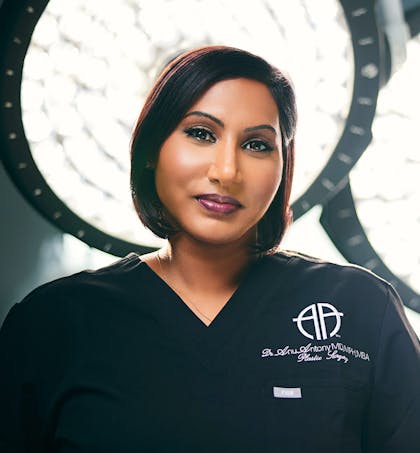
Dr. Anu Antony, a Harvard and Stanford- trained board-certified plastic surgeon with formal training in art from the Lorenzo Medici Institute of Art, emphasizes that achieving a successful outcome requires a precise balance, ensuring that structural reinforcements do not compromise the natural contours or aesthetic harmony of the face. Unlike approaches that overlook facial balance and proportions, her approach blends anatomy with artistry, guided by a commitment to education, precision, and natural, enduring results.
As patients become increasingly educated about facial rejuvenation, terms such as deep plane facelift, SMAS facelift, mini facelift, vertical facelift, and extended deep plane facelift have become commonplace. Yet many patients remain uncertain about what these procedures actually involve and how they differ from one another.
This comprehensive guide explores the science, anatomy, and surgical techniques behind modern facelift surgery and explains how today’s procedures address facial aging at every level.
Modern white plastic surgery consultation office with elegant gold accents in a luxury for private facial rejuvenation consultation in an aesthetic practice setting.

A quiet, private consultation room. Facelift planning begins with an unhurried conversation about anatomy, goals, and the right technique for your personalized facelift and facial rejuvenation planning.
The History and Evolution of Facelift Surgery
Understanding the evolution of facelift surgery helps explain why modern procedures produce such natural-looking results.
Early Facelifts: The Skin-Tightening Era
The earliest facelift procedures emerged in Europe during the early 1900s. These operations primarily involved removing excess skin and pulling the remaining skin tighter.
While patients often experienced immediate improvement, the results were frequently short-lived because the deeper structures responsible for facial support remained untreated.
Common problems included:
- Overly tight appearance
- Distorted facial expression
- Poor longevity
- Visible tension around the ears
- Recurrence of jowls
Surgeons gradually realized that aging involved more than loose skin alone.
The Discovery of the SMAS
One of the most important milestones in facelift surgery occurred in 1976 when French surgeons Mitz and Peyronie described the Superficial Musculoaponeurotic System (SMAS).
This fibromuscular layer extends throughout the face and acts as a key structural support system for facial soft tissues.
Their landmark publication transformed facial rejuvenation surgery by demonstrating that deeper tissues could be repositioned rather than relying solely on skin tension.
This discovery laid the foundation for virtually every modern facelift performed today.
The Rise of SMAS Facelifts
During the 1980s and 1990s, surgeons began developing techniques that directly manipulated the SMAS layer.
Several approaches emerged:
SMAS Plication
The SMAS is folded and tightened without removal.
SMASectomy
A portion of the SMAS is removed and sutured together.
Extended SMAS Techniques
The SMAS is elevated more extensively to improve correction of the midface and neck.
These procedures dramatically improved longevity and produced more natural outcomes than traditional skin-only facelifts.
Hamra and the Composite Facelift
Dr. Sam Hamra further revolutionized facelift surgery through his work on composite rhytidectomy.
Hamra proposed that the face should be treated as an integrated anatomical unit rather than separate layers.
His work emphasized:
- Midface elevation
- Orbicularis muscle repositioning
- Restoration of youthful cheek fullness
- Natural facial movement
Many of the principles established by Hamra continue to influence contemporary deep plane surgery.
The Emergence of Deep Plane Surgery
By the late 1990s and early 2000s, deep plane techniques gained increasing popularity.
Unlike traditional SMAS procedures, deep plane surgery involves releasing key facial retaining ligaments that tether aging tissues to deeper structures.
These ligaments include:
- Zygomatic ligaments
- Masseteric ligaments
- Mandibular ligaments
By releasing these structures, surgeons can reposition facial tissues more effectively and achieve greater improvement in:
- Midface descent
- Nasolabial folds
- Jowls
- Jawline definition
Today, deep plane facelifts are among the most discussed procedures in aesthetic surgery.
Facial layers relevant to deep plane facelift surgery showing skin, subcutaneous fat, SMAS, parotid-masseteric fascia, and facial mimetic muscles.
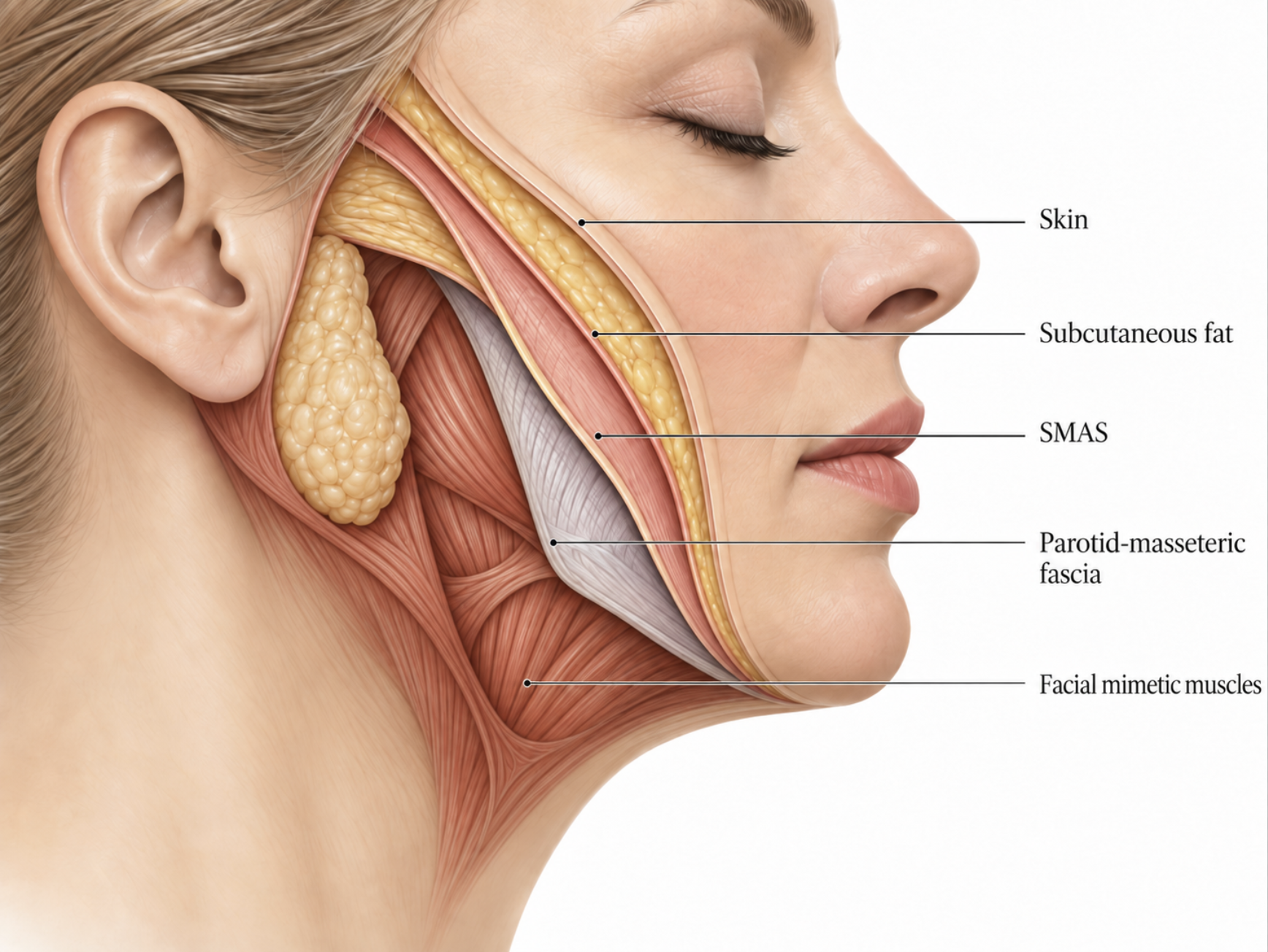
Deep plane facelift addresses the deeper facial layers, including the SMAS and underlying tissue planes.
Understanding Why Faces Age
To understand facelift surgery, it is essential to understand facial aging.
For decades, facial aging was thought to be primarily a skin problem. Modern anatomical research has demonstrated that aging affects multiple layers simultaneously.
Facial aging occurs at four distinct levels:
- Skin
- Fat
- Muscular and fascial support structures
- Bone
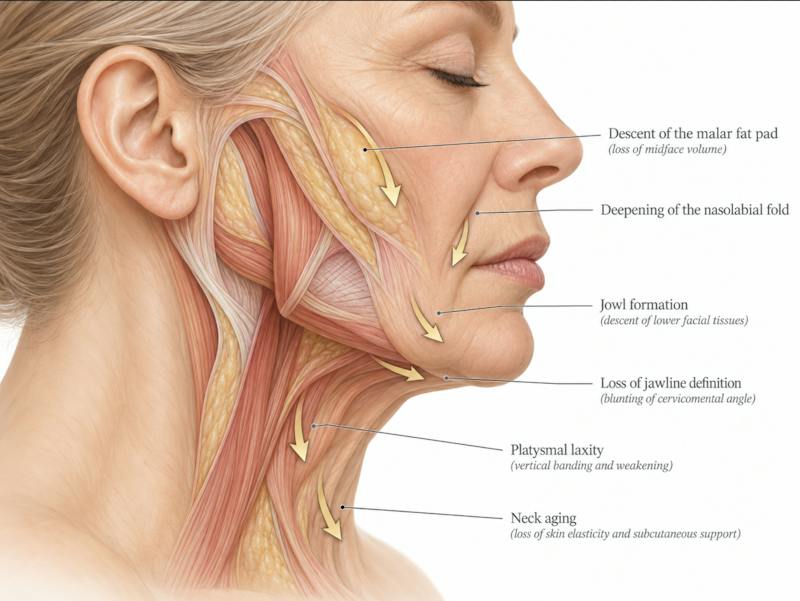
Medical illustration showing facial aging, soft tissue descent, and structural changes relevant to facelift surgery.
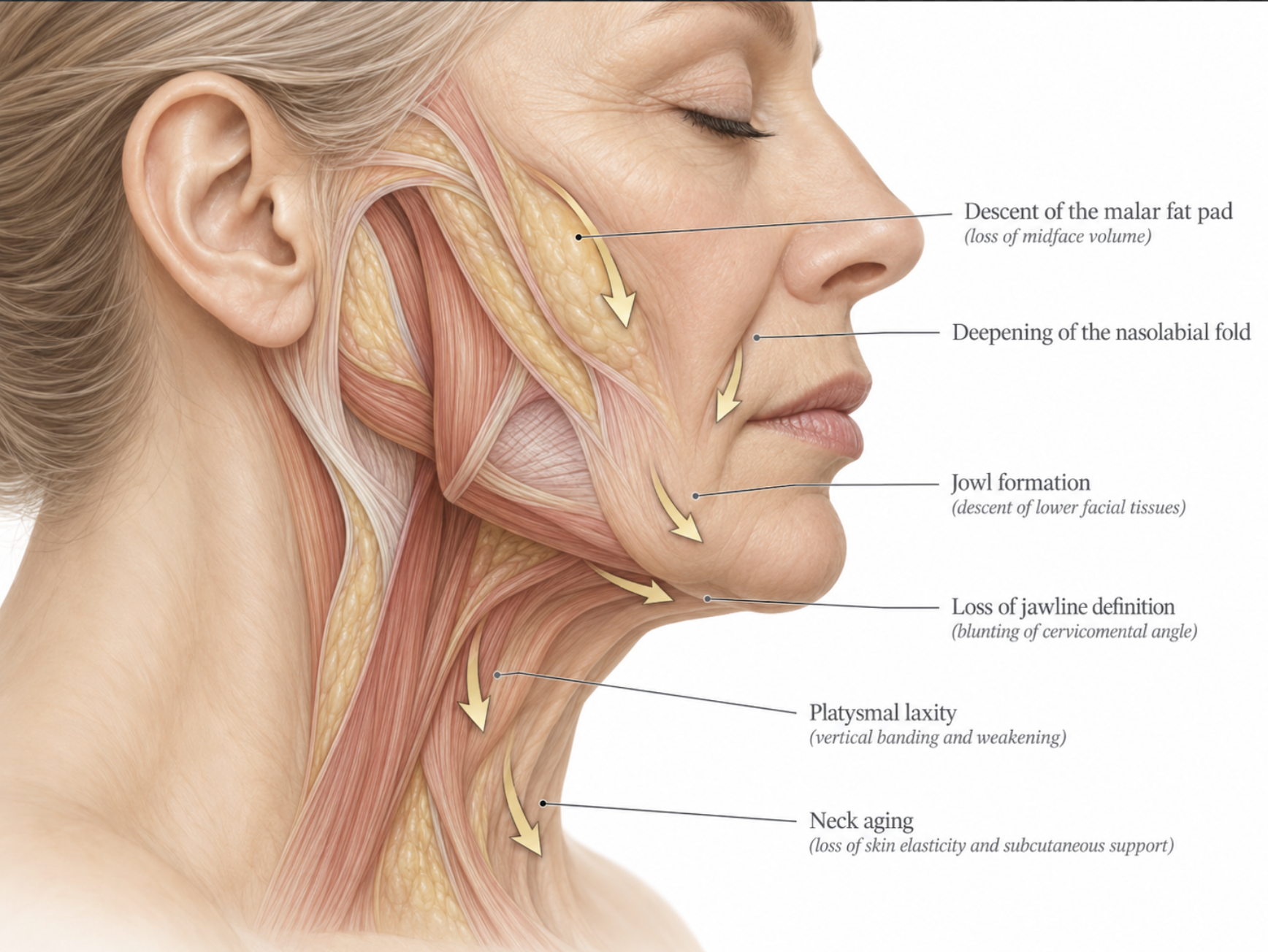
Facial aging involves skin laxity, volume loss, and descent of the deeper tissues that contribute to jowling and midface changes.
Skin Aging
The most visible signs of aging occur within the skin.
Over time:
- Collagen production decreases
- Elastin fibers weaken
- Skin hydration declines
- Sun damage accumulates
These changes contribute to:
- Fine lines
- Wrinkles
- Skin laxity
- Crepey texture
While facelift surgery improves loose skin, it does not directly improve skin quality.
For this reason, many surgeons combine facelift surgery with:
- Laser resurfacing
- Chemical peels
- Microneedling
- Medical-grade skincare (Dr. Antony has her own line of luxury medical-grade skincare called Anu Science of Beauty by Dr. Anu Antony)
Clean, modern plastic surgery office with a medspa that provides laser resurfacing, chemical peels, microneedling, and medical-grade skincare.

Facelift surgery repositions deeper tissue, but it does not change skin quality — resurfacing, peels, microneedling, and medical-grade skincare address surface texture and tone.
Fat Compartment Changes
One of the most significant discoveries in modern facial aging research involves facial fat compartments.
The youthful face contains multiple distinct fat pads that provide volume and support.
With age:
- Some fat compartments shrink
- Others descend downward
- Facial volume becomes redistributed
This process contributes to:
- Hollow temples
- Flattened cheeks
- Tear troughs
- Deep nasolabial folds
- Marionette lines
Many modern facelift procedures are combined with fat grafting to restore lost volume.
Illustration of structural fat grafting zones for facial volume restoration in facelift and facial rejuvenation surgery.
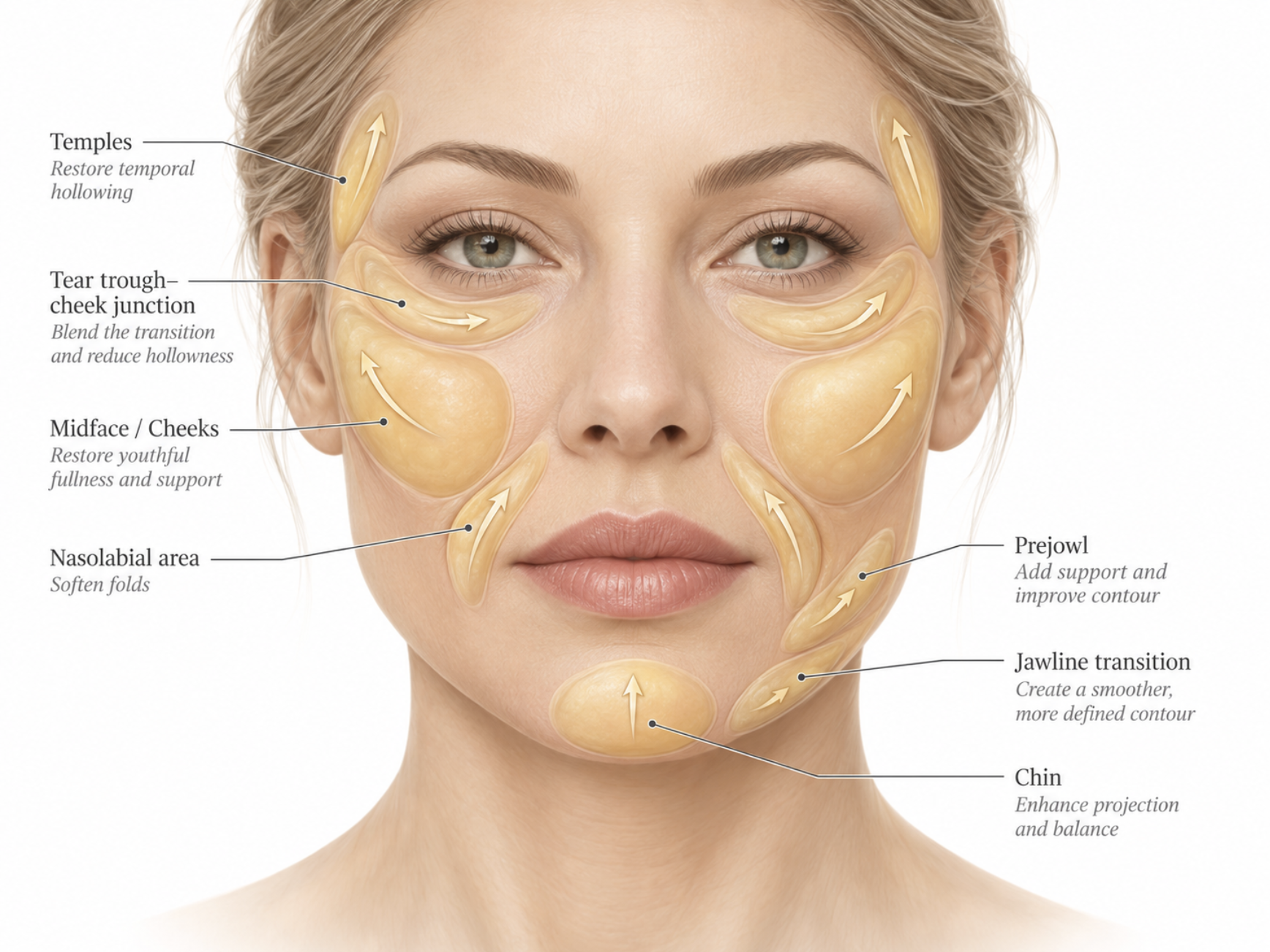
Structural fat grafting restores volume in key areas of the face and is often combined with facelift surgery for comprehensive rejuvenation.
Retaining Ligament Laxity
The face contains numerous retaining ligaments that suspend facial tissues.
These structures anchor the skin, fat, and SMAS to deeper tissues.
Over time:
- Ligaments stretch
- Facial support weakens
- Tissues descend
This descent creates many classic signs of aging:
Midface Descent
The cheeks gradually fall downward.
Jowls
Tissue accumulates along the jawline.
Nasolabial Folds
The folds extending from the nose to the mouth deepen.
Marionette Lines
Vertical folds develop around the corners of the mouth.
Deep plane surgery specifically targets these retaining ligaments.
Skeletal Aging
Aging also affects the facial skeleton.
Research has demonstrated that facial bones undergo gradual remodeling throughout life.
Common changes include:
- Orbital widening
- Maxillary retrusion
- Mandibular changes
- Loss of skeletal projection
These alterations reduce support for overlying soft tissues and contribute to facial sagging.
This discovery helps explain why modern rejuvenation often requires both lifting and volume restoration.
Facial Anatomy Relevant to Facelift Surgery
A sophisticated understanding of facial anatomy is essential for successful facelift surgery.
Modern procedures focus on three key anatomical layers:
Skin
The most superficial layer.
Subcutaneous Fat
Provides contour and volume.
SMAS
The critical structural layer manipulated during facelift surgery.
Beneath these layers lie facial nerves, blood vessels, muscles, and retaining ligaments that must be carefully preserved during surgery.
The SMAS: The Foundation of Modern Facelifts
The SMAS is arguably the most important anatomical structure in facelift surgery.
This fibromuscular layer connects:
- Facial muscles
- Subcutaneous tissues
- Skin
Because the SMAS moves naturally with facial expression, repositioning it produces more natural outcomes than skin tightening alone.
Benefits of SMAS manipulation include:
- Improved longevity
- Better contour
- Reduced skin tension
- More natural facial movement
Virtually all contemporary facelift techniques involve some degree of SMAS modification.
Facial Retaining Ligaments
Retaining ligaments function like suspension cables for the face.
Important examples include:
Zygomatic Ligaments
Support the cheek region.
Masseteric Ligaments
Influence lower face contour.
Mandibular Ligaments
Contribute to jowl formation.
Traditional SMAS facelifts often leave these structures intact.
Deep plane surgery typically releases many of these ligaments to permit greater tissue mobilization.
This distinction represents one of the primary differences between SMAS and deep plane techniques.
The Modern Philosophy of Facial Rejuvenation
The philosophy of facial rejuvenation has changed dramatically over the past several decades.
Older approaches focused on:
- Tightening skin
- Removing excess tissue
Modern approaches focus on:
- Restoring anatomy
- Repositioning descended structures
- Preserving facial identity
- Maintaining natural expression
- Recreating youthful contours
The best facelift should not make a patient look “different.”
Instead, it should create the appearance of a more rested, youthful version of themselves.
This principle guides contemporary facelift surgery and explains why deep plane, SMAS, and advanced neck rejuvenation techniques continue to evolve.
Types of Facelifts: An Overview
Today, surgeons may offer several facelift options, including:
- Mini Facelift
- Short Scar Facelift
- SMAS Facelift
- High-SMAS Facelift
- Deep Plane Facelift
- Extended Deep Plane Facelift
- Composite Facelift
- Vertical Facelift
Each procedure has specific advantages, limitations, and indications.
Comparing the Major Types of Facelift Surgery
Modern facelift surgery is not a single procedure. Instead, it represents a spectrum of techniques designed to address different degrees of facial aging.
The ideal procedure depends on:
- Patient age
- Skin quality
- Degree of facial laxity
- Presence of jowls
- Neck aging
- Desired recovery time
- Long-term goals
Understanding the differences between facelift techniques helps patients make informed decisions.
Skin-Only Facelift
Although rarely performed as a standalone procedure today, the skin-only facelift represents the foundation of facelift surgery.
How It Works
The surgeon elevates the skin and removes excess tissue without manipulating deeper structures.
Advantages
- Shorter operative time
- Less extensive dissection
- Faster recovery
Disadvantages
- Limited longevity
- Greater tension on skin
- Higher risk of visible pulling
- Minimal improvement of deep facial structures
Most contemporary facelift surgeons believe skin-only lifts provide inferior long-term outcomes compared with SMAS-based procedures.
Mini Facelift
The mini facelift is designed for patients experiencing early signs of facial aging.
Ideal Candidates
Typically:
- Ages 40–55
- Mild jowling
- Minimal neck aging
- Good skin elasticity
Surgical Approach
Smaller incisions are used around the ears.
The procedure focuses primarily on:
- Early jowls
- Mild skin laxity
- Lower face contour
Advantages
- Shorter recovery
- Smaller scars
- Reduced downtime
- Lower procedural complexity
Limitations
A mini facelift does not typically address:
- Significant neck aging
- Severe jowls
- Midface descent
- Advanced facial laxity
Patients seeking dramatic rejuvenation often require more comprehensive techniques.
Short Scar Facelift
The short scar facelift attempts to provide meaningful improvement while minimizing incision length.
Characteristics
Incisions are generally limited to:
- Front of the ear
- Around the earlobe
The procedure is commonly combined with SMAS tightening.
Benefits
- Smaller scars
- Faster recovery
- Natural improvement
Drawbacks
- Less effective neck correction
- Limited tissue mobilization
- Reduced longevity in some patients
SMAS Facelift
The SMAS facelift remains one of the most widely performed facelift procedures worldwide.
What Is the SMAS?
The superficial musculoaponeurotic system acts as the structural framework of the face.
Rather than pulling skin alone, surgeons reposition the SMAS layer.
Surgical Techniques
Several SMAS variations exist:
SMAS Plication
The SMAS is folded and tightened.
SMASectomy
A portion of the SMAS is excised.
Extended SMAS
The SMAS is elevated more extensively into the cheek and neck.
Advantages
- Natural appearance
- Excellent longevity
- Improved jawline
- Better correction of jowls
Limitations
While highly effective, some surgeons believe traditional SMAS techniques provide less dramatic improvement in:
- Nasolabial folds
- Midface descent
- Deep cheek aging
These concerns contributed to the popularity of deep plane surgery.
High-SMAS Facelift
The high-SMAS facelift extends dissection superiorly into the cheek.
Goals
- Improve cheek elevation
- Enhance midface correction
- Reduce nasolabial folds
Many surgeons view the high-SMAS approach as a bridge between traditional SMAS surgery and deep plane techniques.
Benefits
- Better midface rejuvenation
- Improved cheek contour
- Natural outcomes
Considerations
The procedure requires advanced anatomical knowledge and surgical expertise.
Deep Plane Facelift
The deep plane facelift has become one of the most sought-after facial rejuvenation procedures in modern plastic surgery.
What Makes It Different?
Traditional facelifts separate skin from underlying structures.
Deep plane surgery elevates:
- Skin
- Fat
- SMAS
As a single anatomical unit.
The procedure also releases facial retaining ligaments.
Structures Released
Typically:
- Zygomatic ligaments
- Masseteric ligaments
- Mandibular ligaments
This release permits greater tissue mobilization.
Advantages
Many surgeons believe deep plane surgery offers:
- Superior midface elevation
- Better nasolabial fold improvement
- More natural movement
- Longer-lasting correction
Candidates
Ideal candidates often include:
- Significant jowls
- Midface descent
- Advanced facial aging
- Moderate-to-severe neck laxity
Recovery
Deep plane procedures generally involve:
- More swelling initially
- Longer operative times
- Similar long-term recovery compared with SMAS procedures
Extended Deep Plane Facelift
An extended deep plane facelift expands treatment into the neck and lower facial structures.
Additional Components
Often includes:
- Platysmaplasty
- Deep neck contouring
- Jawline sculpting
- Cervical rejuvenation
Benefits
This approach can produce dramatic improvement in:
- Jawline definition
- Neck contour
- Facial harmony
Many experts consider the neck equally important as the face when pursuing comprehensive rejuvenation.
Composite Facelift
Dr. Sam Hamra pioneered the composite facelift.
Philosophy
Rather than treating structures separately, the face is rejuvenated as an integrated unit.
Key Features
- Orbicularis muscle repositioning
- Midface elevation
- Lower eyelid rejuvenation
- Cheek restoration
Benefits
- Excellent midface rejuvenation
- Natural appearance
- Comprehensive correction
Challenges
The composite facelift is technically demanding and performed by a smaller group of highly specialized surgeons.
Vertical Facelift
Traditional facelifts often pull tissues in a predominantly lateral direction.
Vertical facelifts emphasize upward repositioning.
Goals
- Restore youthful cheek position
- Improve jawline contour
- Mimic natural aging reversal
Many modern deep plane procedures incorporate vertical vectors.
Upper Face Rejuvenation
A facelift primarily treats the lower two-thirds of the face.
Many patients benefit from simultaneous upper facial rejuvenation.
Brow Lift
The brow gradually descends with age.
Common signs include:
- Hooded eyelids
- Heavy brows
- Forehead wrinkles
- Tired appearance
Brow Lift Options
Endoscopic Brow Lift
Minimally invasive.
Temporal Brow Lift
Focuses on the outer brow.
Coronal Brow Lift
Less common today.
Combining brow lifting with facelift surgery often produces a more balanced result.
Eyelid Surgery (Blepharoplasty)
The eyes are frequently among the first areas to reveal aging.
Common concerns include:
- Upper eyelid hooding
- Lower eyelid bags
- Excess skin
- Hollowing
Blepharoplasty complements facelift surgery by rejuvenating the periocular region.
Midface Rejuvenation
The midface undergoes some of the most significant age-related changes.
Signs of Midface Aging
Patients frequently develop:
- Flattened cheeks
- Tear troughs
- Nasolabial folds
- Facial hollowing
These changes occur because cheek fat compartments descend over time.
Midface Lift Techniques
Several options exist:
Deep Plane Facelift
Provides direct elevation of descended cheek tissues.
Endoscopic Midface Lift
Often used in younger patients.
Fat Grafting
Combination Procedures
Frequently produce the most comprehensive outcomes.
The midface remains one of the most challenging regions to rejuvenate effectively.
Lower Face Rejuvenation
The lower face strongly influences perceptions of youth and attractiveness.
Jowls
Jowls develop when tissues descend below the jawline.
They are among the most common reasons patients seek facelift surgery.
Marionette Lines
These folds extend downward from the corners of the mouth.
They can create:
- Sad appearance
- Fatigued appearance
- Older facial expression
Modern facelift techniques improve these lines indirectly through tissue repositioning.
Jawline Definition
A youthful jawline is:
- Sharp
- Continuous
- Well-defined
Facelift surgery restores jawline definition by repositioning descended tissues.
Neck Lift Surgery
The neck often ages simultaneously with the face.
In some patients, neck aging is actually the primary concern.
Why the Neck Ages
Contributors include:
- Skin laxity
- Excess fat
- Platysma separation
- Skeletal changes
Platysma Bands
Vertical neck bands become increasingly visible with age.
These bands result from separation of the platysma muscle.
Components of Neck Lift Surgery
Liposuction
Removes excess fat.
Platysmaplasty
Repairs platysma separation.
Skin Tightening
Improves contour.
Deep Neck Contouring
Addresses deeper anatomical structures.
Deep Neck Lift
Some surgeons now perform specialized deep neck procedures.
These may address:
- Deep fat
- Digastric muscles
- Submandibular gland prominence
The goal is creating a more youthful cervicomental angle.
Deep Plane vs. SMAS Facelift: What Does the Evidence Show?
This remains one of the most debated topics in aesthetic surgery.
Areas of Agreement
- High patient satisfaction
- Excellent aesthetic outcomes
- Acceptable complication rates
with both techniques.
Potential Advantages of Deep Plane Surgery
Studies suggest potential improvements in:
- Midface elevation
- Nasolabial folds
- Natural tissue movement
Advantages of SMAS Surgery
SMAS procedures offer:
- Predictable outcomes
- Long-term success
- Broad surgeon familiarity
- Excellent safety profile
What Matters Most?
Many experts agree that surgeon expertise is often more important than the specific facelift label.
A beautifully executed SMAS facelift may outperform a poorly performed deep plane facelift.
Luxury facial rejuvenation treatment suite with white interiors and gold accents in a modern aesthetic plastic surgery office.
Recovery is staged, not sudden. Most patients look socially presentable within two to three weeks, while final facelift results mature over several months. Advanced facial rejuvenation begins in a modern, thoughtfully designed treatment environment.
Recovery Timeline
Days 1–3
- Swelling
- Bruising
- Tightness
Week 1
- Drain removal if used
- Initial healing
Week 2
- Significant improvement
- Return to many daily activities
Weeks 3–6
- Continued swelling resolution
- Improving facial contours
Months 3–6
- Progressive refinement
Year 1
- Final results typically evident
Patience is essential. The most natural results often emerge gradually over several months.
Risks and Complications
All surgical procedures carry risks.
Potential facelift complications include:
- Hematoma
- Infection
- Nerve injury
- Delayed wound healing
- Hairline distortion
- Asymmetry
- Scarring
- Revision surgery
Fortunately, serious complications remain relatively uncommon when procedures are performed by qualified, experienced surgeons.
Looking Ahead
The final section of this guide will address the most common facelift questions, provide a detailed FAQ, summarize key ASPS and PubMed resources, discuss educational videos, and offer guidance on selecting the right facelift procedure for your anatomy and goals.
Frequently Asked Questions About Facelift Surgery
1. How Long Does a Facelift Last?
One of the most common questions patients ask is how long their results will last.
Although no facelift can permanently stop the aging process, modern techniques can produce long-lasting improvement.
Typical longevity:
- Mini facelift: 5–7 years
- SMAS facelift: 8–12 years
- Deep plane facelift: 10–15 years or longer
- Neck lift: 10–15 years
The longevity of results depends on:
- Genetics
- Skin quality
- Sun exposure
- Smoking history
- Weight fluctuations
- Surgical technique
Patients will continue to age after surgery, but they generally maintain a more youthful appearance than if they had never undergone treatment.
2. What Is the Best Age for a Facelift?
There is no universally ideal age.
Most facelift patients fall between:
- 45 and 70 years old
However, age alone is less important than anatomy.
A younger patient with significant facial laxity may be an excellent candidate, while an older patient with minimal tissue descent may not require surgery.
Most surgeons focus on:
- Skin quality
- Facial anatomy
- Degree of aging
- Patient goals
rather than chronological age.
3. Is a Deep Plane Facelift Better Than a SMAS Facelift?
This remains one of the most debated topics in facial plastic surgery.
- Both procedures can achieve excellent outcomes.
- Both procedures demonstrate high patient satisfaction.
- Both techniques have favorable safety profiles.
Potential advantages of deep plane surgery include:
- Enhanced midface elevation
- Better nasolabial fold correction
- More extensive tissue mobilization
Advantages of SMAS surgery include:
- Proven long-term success
- Excellent safety record
- Broad surgeon familiarity
Many experts believe surgeon experience is more important than the specific technique employed.
4. Will I Look Natural After a Facelift?
A properly performed facelift should not make you appear “different.”
The goal of modern facial rejuvenation is restoration rather than transformation.
The best facelift outcomes typically result in comments such as:
- “You look refreshed.”
- “You look rested.”
- “You look younger.”
without obvious signs of surgery.
Natural-looking results are a hallmark of contemporary facelift techniques.
5. Does a Facelift Improve Wrinkles?
A facelift primarily addresses:
- Sagging skin
- Jowls
- Facial laxity
- Neck aging
It does not directly treat:
- Fine lines
- Sun damage
- Surface wrinkles
For this reason, many surgeons combine facelift surgery with:
- Laser resurfacing
- Chemical peels
- Microneedling
- Medical-grade skincare
to address skin quality.
6. Can Men Have Facelifts?
Absolutely.
Male facelift surgery has become increasingly common.
Men frequently seek treatment for:
- Jowls
- Neck laxity
- Heavy lower face
- Loss of jawline definition
Male facelift surgery requires specialized planning because male facial anatomy differs from female anatomy.
Important considerations include:
- Beard-bearing skin
- Stronger jawline
- Hairline preservation
- Masculine facial proportions
7. How Painful Is Facelift Recovery?
Most patients report surprisingly little pain.
Common sensations include:
- Tightness
- Pressure
- Swelling
- Mild discomfort
Severe pain is uncommon.
Most discomfort is well controlled with medication during the early postoperative period.
8. How Long Is Recovery?
Recovery varies according to procedure type.
General timeline:
Week 1
- Swelling
- Bruising
- Limited activity
Week 2
- Return to many social activities
Weeks 3–6
- Continued refinement
Months 3–12
- Final maturation of results
Most patients feel socially comfortable within 2–3 weeks.
9. Can a Facelift Be Combined with Other Procedures?
Yes.
Common combinations include:
Eyelid Surgery
Improves upper and lower eyelids.
Brow Lift
Addresses forehead and brow aging.
Fat Grafting
Restores facial volume.
Laser Resurfacing
Improves skin quality.
Neck Lift
Enhances jawline and neck contour.
Comprehensive facial rejuvenation often requires a combination approach.
10. Will a Facelift Eliminate My Nasolabial Folds?
Deepening of the nasolabial folds results from multiple factors.
Facelift surgery can improve these folds by:
- Elevating cheek tissues
- Restoring facial support
However, very deep folds may not disappear completely.
Additional treatments may include:
- Fat grafting
- Fillers
- Skin resurfacing
11. What Is the Difference Between a Facelift and a Neck Lift?
A facelift primarily treats:
- Jowls
- Jawline
- Lower face
A neck lift focuses on:
- Neck laxity
- Platysmal bands
- Excess neck skin
- Neck fat
Many patients benefit from combining both procedures.
12. What Is a Mini Facelift?
A mini facelift is a less invasive procedure designed for:
- Early facial aging
- Mild jowls
- Minimal neck laxity
It generally provides:
- Faster recovery
- Smaller incisions
but less dramatic correction than comprehensive facelift surgery.
13. Can a Facelift Be Revised?
Yes.
Revision facelifts are performed for:
- Recurrent aging
- Incomplete correction
- Prior unsatisfactory outcomes
Revision surgery is often more complex due to scar tissue and altered anatomy.
14. Will Insurance Cover a Facelift?
Facelift surgery is generally considered cosmetic and is not covered by insurance.
Exceptions may occur when functional reconstructive procedures are performed simultaneously.
Clean white physician consultation office with a marble desk and gold accents in a modern board-certified plastic surgery practice.
Choosing a board-certified surgeon with focused facial rejuvenation expertise matters.
15. How Do I Choose the Right Surgeon?
This may be the most important decision a patient makes.
Look for:
- Board certification
- Extensive facelift experience
- Before-and-after photographs
- Accredited surgical facilities
- Strong patient reviews
- Focused expertise in facial rejuvenation
The American Society of Plastic Surgeons recommends selecting a qualified surgeon with appropriate training and experience.
Recommended Educational Videos
American Society of Plastic Surgeons (ASPS)
Deep Plane Facelift Explained
American Academy of Facial Plastic and Reconstructive Surgery
American Academy of Facial Plastic and Reconstructive Surgery